Mesh Wi-Fi Systems Guide
Mesh systems solve whole-home coverage properly. One SSID, seamless roaming, and consistent speeds everywhere - no more dead zones or separate network names.
What Is a Mesh Wi-Fi System?
A mesh system consists of multiple units (nodes) that work together as a single coordinated network. Unlike a range extender that simply repeats a signal at reduced bandwidth, mesh nodes communicate directly with each other on a dedicated backhaul channel and present themselves to devices as one seamless network. Your phone switches between nodes automatically as you move through the house without disconnecting.
- Advantages. Whole-home coverage, seamless roaming, single SSID, easy management via app, scales by adding nodes.
- Disadvantages. Higher cost than a single router, less advanced configuration options, often requires cloud account.
- vs Range Extender. Extenders half bandwidth and create separate networks. Mesh nodes maintain full speeds and seamless roaming. Mesh is significantly better for most homes.
- Best For. Homes over 1,500 sq ft, multi-floor houses, homes with thick walls, and anyone who wants reliable coverage without technical complexity.
Popular Mesh Systems
| System | Wi-Fi Standard | Management | Notes |
|---|---|---|---|
Google Nest WiFi Pro | WiFi 6E | Google Home app | No web admin panel |
TP-Link Deco XE75 | WiFi 6E | Deco app | Good value, HomeCare included |
Asus ZenWiFi Pro ET12 | WiFi 6E | Browser + ASUS app | Advanced features, AiMesh |
Netgear Orbi RBK863S | WiFi 6E | Orbi app | Very fast backhaul, expensive |
Eero Pro 6E | WiFi 6E | Eero app (Amazon) | Simple, no web panel |
TP-Link Deco XE75 (3-pack) | WiFi 6E | Deco app | Best value for large homes |
General Mesh Setup Steps
- 1Download the manufacturer app
Almost all mesh systems are set up through a mobile app (Deco, Google Home, Eero, Orbi, ASUS Router). Download it before unboxing the hardware.
- 2Connect the primary node to your modem
Plug an Ethernet cable from your modem or ISP router into the WAN port of the primary mesh node. Power it on and wait for it to initialise.
- 3Follow the app setup wizard
The app scans for the primary node via Bluetooth or Wi-Fi. Follow the on-screen steps to configure your SSID, password, and internet connection type.
- 4Add satellite nodes
Place each additional node roughly halfway between the primary node and the area you want to cover. Power on and add through the app. The app usually shows signal strength to guide placement.
Do You Actually Need Mesh?
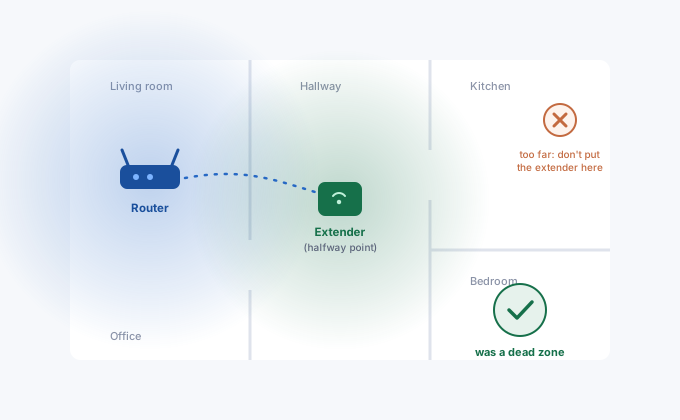
Mesh got marketed so hard that people buy three-node kits for one-bedroom flats. The honest sizing rule: on a single floor under roughly 100 m² with the router anywhere near the middle, a single decent router covers it, and the mesh kit buys you nothing but extra boxes to dust. Mesh earns its price in multi-floor houses, long narrow homes where the router sits at one end, buildings with thick masonry or that one cursed steel-reinforced wall, and anywhere you'd otherwise chain extenders together.
The in-between cases usually resolve on placement, not hardware. A router hidden in a cupboard at the far corner of the house performs dramatically worse than the same router out in the open near the centre. Try the free fix first: move the router, then walk the house with a speed test. If the weak rooms are still weak, now you have your answer, and you also know exactly where a mesh node should go.
The Backhaul Is the Whole Product
Every mesh system lives or dies on its backhaul, the link that carries traffic between nodes. Cheap dual-band kits share one 5 GHz radio between serving your devices and talking to each other, so the far node delivers a fraction of the speed. Tri-band systems dedicate a radio to the job and hold up far better. And wired backhaul, an Ethernet cable between nodes, beats everything at any price: with a cable, the cheapest kits perform like the expensive ones. If your home has Ethernet runs, or you can add even one, buy the cheaper kit and wire it. This single decision matters more than the brand.
Related buying note: mesh ecosystems are closed. Eero talks only to Eero, Deco to Deco, Orbi to Orbi. Whatever you pick, you're committing to that family for expansion, so check the price of add-on nodes before you commit to the starter kit, some brands sell cheap kits and expensive expansions.